


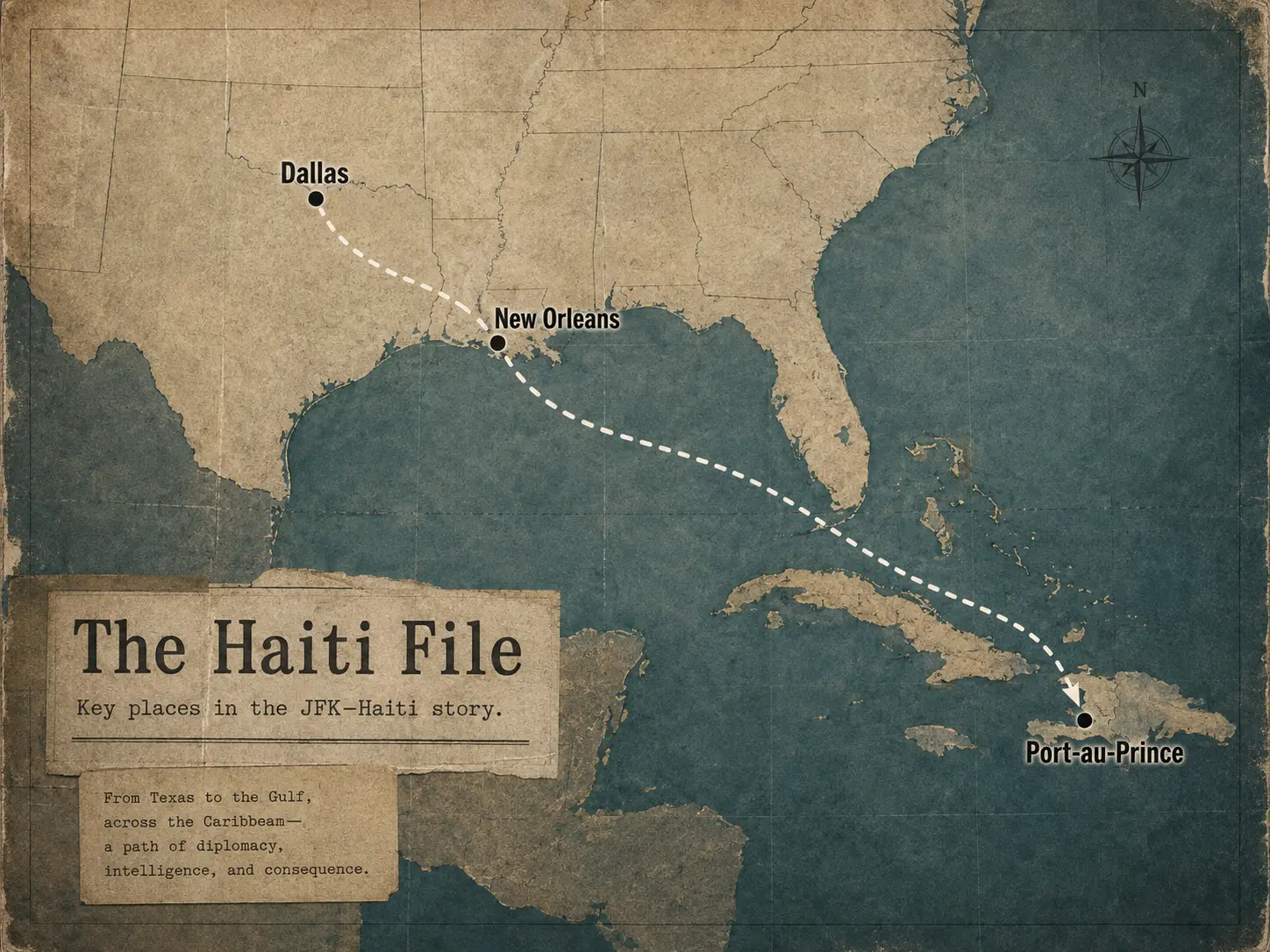
The JFK Haiti connection: a documented look at George de Mohrenschildt’s Haiti venture, the Kennedy administration’s 1963 pressure campaign against François Duvalier, and published accounts of champagne at Haiti’s National Palace after Kennedy was killed.
Free Haiti • Historical Investigation
EDITOR’S NOTE
This article separates established historical facts from reported recollections and later allegations. Nothing in the records cited below establishes that François Duvalier, George de Mohrenschildt, or the Haitian government participated in the assassination of President John F. Kennedy.
The country that rarely appears in the JFK conversation
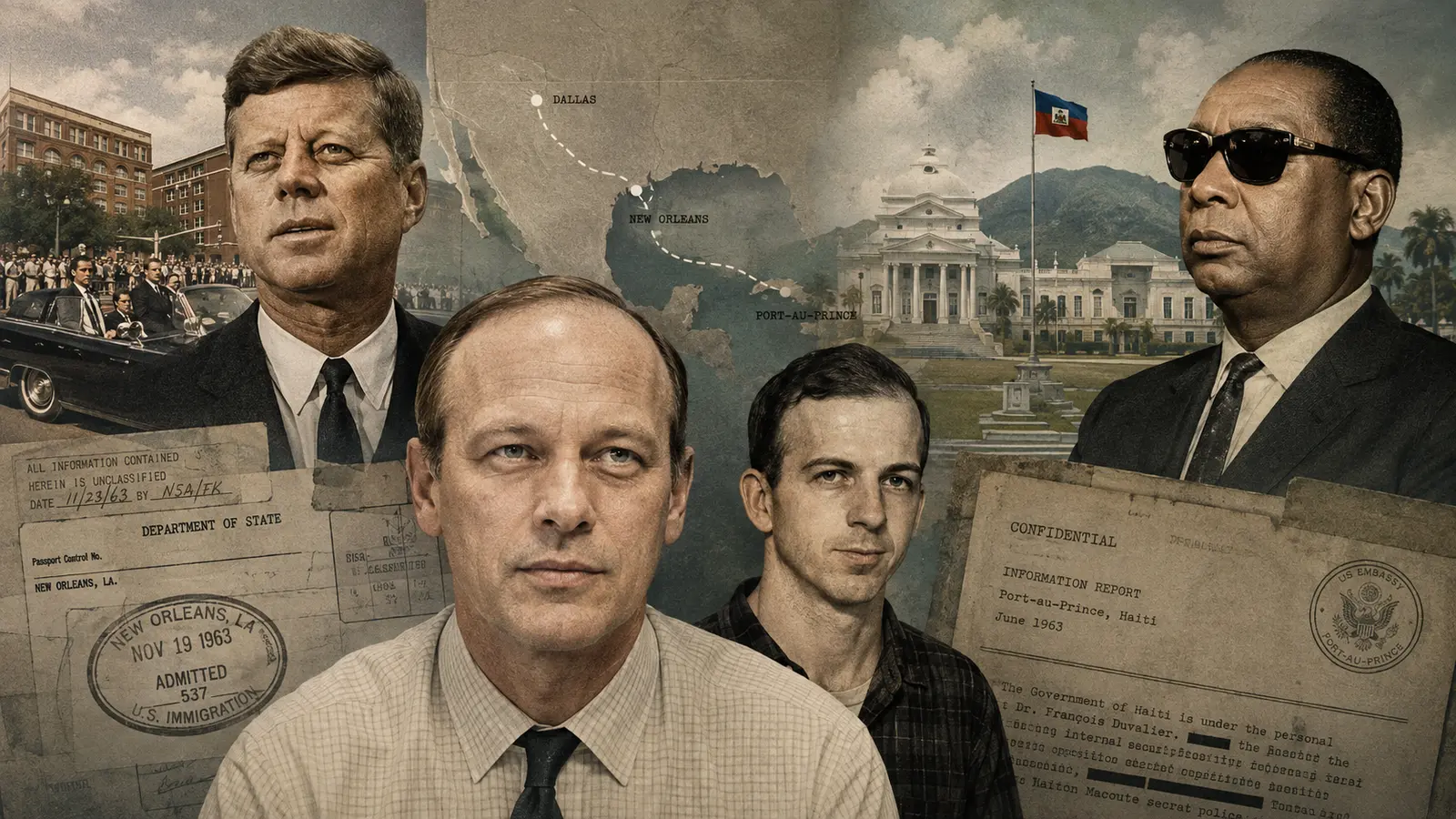
The assassination of John F. Kennedy has produced an enormous geography of suspicion: Dallas, New Orleans, Havana, Mexico City, Moscow, Miami. Haiti is usually missing from that list. Yet Haiti appears in the official record at an unexpectedly sensitive point in 1963, through two separate stories that unfold at the same time.
The first concerns George de Mohrenschildt, a Russian-born petroleum geologist and one of the few people in Dallas for whom Lee Harvey Oswald appeared to have genuine respect. The second concerns a rapidly deteriorating confrontation between the Kennedy administration and Haitian president François “Papa Doc” Duvalier.[1]
Those stories do not prove a common plot. But when read beside one another, they create an unusual historical intersection: Oswald’s well-connected acquaintance moved to Haiti in June 1963, while Washington was actively considering how to isolate, weaken, and potentially remove Duvalier. Five months later Kennedy was dead.
George de Mohrenschildt: Oswald’s unlikely friend
George de Mohrenschildt did not fit the profile of Lee Harvey Oswald’s ordinary social circle. He was educated, multilingual, internationally traveled, and worked in petroleum geology. He moved among businesspeople, geologists, and members of Dallas’s Russian-speaking community. Oswald, recently returned from the Soviet Union, was struggling financially and openly espoused Marxist ideas that alienated much of that same community.
The Warren Commission nevertheless found that the de Mohrenschildts continued seeing Lee and Marina Oswald after most of the Russian-speaking circle had pulled away. The Commission described George as apparently the only Russian-speaking person in Dallas for whom Oswald had “appreciable respect.” Their face-to-face contact continued until roughly the time Oswald left for New Orleans in April 1963.[1]
After the de Mohrenschildts left Dallas, the Warren Commission said a postcard from Oswald was apparently their only subsequent contact. The postcard provided Oswald’s new New Orleans address. The de Mohrenschildts then left for Haiti in early June.[1]
The historical question is not whether de Mohrenschildt was a proven “handler.” He was not. The question is why his documented background generated so much later scrutiny.
The CIA connection: real, but frequently overstated
De Mohrenschildt’s association with U.S. intelligence is one of the places where fact and conspiracy literature often blur. The House Select Committee on Assassinations confirmed that J. Walton Moore worked for the CIA’s Domestic Contacts Division in Dallas. That office contacted Americans who could provide information about foreign countries, and Moore had periodic contact with de Mohrenschildt for debriefing purposes.[2]
De Mohrenschildt told the Warren Commission that he believed he had discussed Oswald with Moore. Moore later said he had no recollection of any such conversation and denied that his contacts with de Mohrenschildt concerned Oswald.[2]
The congressional investigation did not establish that de Mohrenschildt befriended Oswald on behalf of the CIA. That distinction is essential. Describing him as Oswald’s proven CIA “handler” goes beyond the evidence. What the record supports is narrower: de Mohrenschildt had a documented relationship with a CIA Domestic Contacts officer before and during the broader period in which he knew Oswald.[2]
Then the trail moves to Haiti
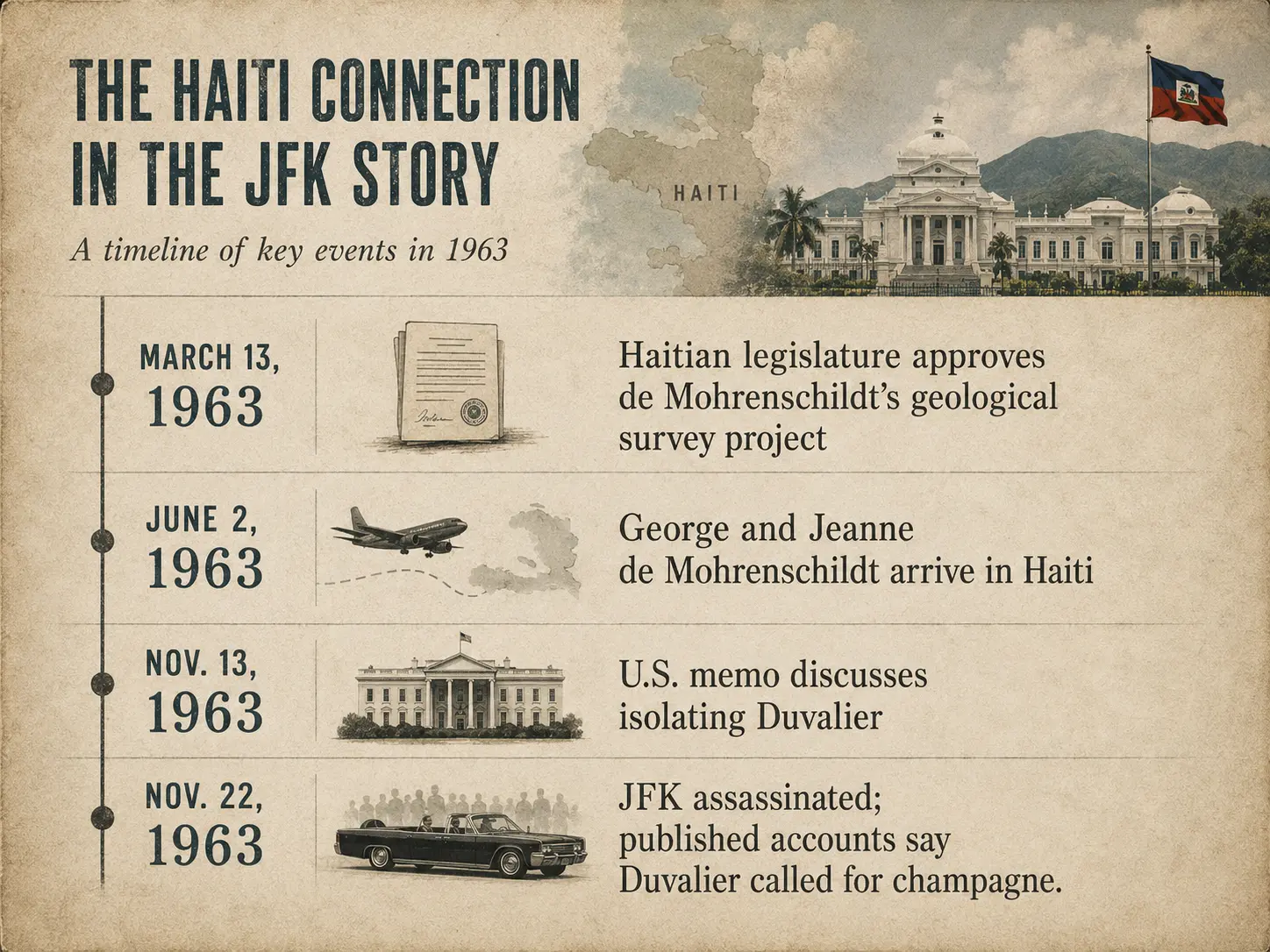
Haiti was not an afterthought in de Mohrenschildt’s life. He had previously worked there as a geologist, and by 1962 he was promoting a broader Haitian commercial venture connected to businessman and banker Clémard Joseph Charles. Warren Commission exhibits preserve letters, promotional material for a proposed Haitian holding company, and even a map of Haiti marked by de Mohrenschildt.[3]
The HSCA later devoted an entire section of its report to “De Mohrenschildt’s Activities in Haiti.” According to that investigation, he went to Haiti in March 1963 to arrange a geological contract. The committee’s chronology states that on March 13 the Congress of Haiti approved a geological survey valued at $285,000, with part of the compensation tied to a ten-year interest in a sisal plantation.[4]
The same congressional report says George and Jeanne de Mohrenschildt arrived in Haiti on June 2, 1963, and were living there at the time of Kennedy’s assassination. De Mohrenschildt described the project as commercial and geological, intended to map petroleum and mineral resources.[4]
This is also where a useful piece of genuine visual evidence survives: De Mohrenschildt Exhibit No. 11, a Texaco road map of Haiti marked in his handwriting and preserved through the Warren Commission/National Archives record. For the web version of this article, it is a stronger image than any dramatization because readers can inspect the actual exhibit themselves.[3]
At the same time, Kennedy and Papa Doc were on a collision course
The other half of the Haiti story was unfolding at the level of state power. By January 1963, the Kennedy administration had concluded that Duvalier intended to remain in office beyond the constitutional end of his term. A State Department memorandum prepared for a presidential meeting stated that Haiti had received no substantial U.S. or international lending assistance since July 1962, that U.S. military matériel shipments had been suspended, and that Washington had blocked roughly $17 million in pending loans because officials believed the money would strengthen Duvalier.[5]
The confrontation sharpened in May. National Security Action Memorandum 246, issued after a meeting with Kennedy, stated that U.S. involvement in a program to unseat Duvalier should, for the time being, be limited to encouraging and helping fund an effort by Haitians. It also called for a determined effort to encourage the development of an exile force that might challenge him.[6]
This was not simply rhetorical hostility. It was a documented policy discussion at the highest level of the U.S. government.
And the pressure had not disappeared by the fall. On November 13, 1963, nine days before Kennedy was assassinated, the State Department drafted a proposed Haiti plan that laid out four broad options. One was to continue isolating Duvalier and attempt to hasten his downfall. Another, far more aggressive option contemplated an all-out effort to remove him and install an acceptable successor, including the possible use of U.S. forces.[7]
Nine days before Dallas, U.S. officials were still writing policy papers about isolating Duvalier, hastening his downfall, or pursuing his removal.
November 22, 1963: reports of champagne at the National Palace
When Kennedy was shot in Dallas on November 22, the news quickly became a global event. In Haiti, however, several published accounts describe a reaction inside the National Palace that was very different from public mourning.
The most important early published account appeared in The Atlantic in November 1967. Retired Marine colonel Robert D. Heinl Jr., who had served as chief of the U.S. naval mission in Haiti, wrote that an official who was present when news of the assassination reached Port-au-Prince said Duvalier called for champagne.[8]
A later firsthand recollection came from American novelist and journalist Herbert Gold. Writing in the Los Angeles Times in 1986, Gold said he had been in Haiti on assignment when Kennedy was killed and recalled that Duvalier conducted a “riotous party” in the National Palace that night, celebrating the fall of an enemy.[9]
The basic champagne story also appears in later scholarship on Duvalier-era foreign relations. Historian Wien Weibert Arthus wrote that on November 22, 1963, Duvalier was drinking champagne at the National Palace because his greatest enemy, John Kennedy, was gone.[10]
What does that prove? It supports the historical claim that Duvalier regarded Kennedy’s death as politically favorable and that celebration at the Palace was reported by people close enough to the events to make the account worth taking seriously. It does not establish that Duvalier had advance knowledge of the assassination, much less that he participated in it.
The curse, the number 22, and Duvalier’s political mythology
The story acquired another layer because Duvalier deliberately cultivated an aura of supernatural authority. Later accounts report that he claimed to have placed a death curse on Kennedy and interpreted the assassination on November 22 as proof of his own power. A 1978 Washington Post profile of Robert and Nancy Heinl summarized the story by noting Duvalier’s attachment to the number 22 and his claim that Kennedy had died because of his curse.[11]
This material should be understood as Duvalierist mythology and political theater, not evidence of supernatural causation. Its importance is political: a dictator who had spent 1963 under intense pressure from Washington could use Kennedy’s death to reinforce a message of invulnerability at home.
The JFK Haiti connection: two trails, one country
By November 1963, two independent historical trails therefore converged in Haiti.
-
The Oswald trail: George de Mohrenschildt, one of Oswald’s closest and most unusual acquaintances, had documented CIA contacts, a Haitian government geological contract, and had been living in Haiti since June.
-
The Duvalier trail: Kennedy’s administration had cut aid, suspended military matériel, blocked development financing, discussed supporting Haitian efforts to unseat Duvalier, and was still considering ways to hasten his downfall nine days before the assassination.
-
The November 22 trail: Published accounts say Duvalier called for champagne and celebrated Kennedy’s death inside the National Palace.
Placed side by side, the chronology is undeniably striking. But chronology is not causation. There is no documentary bridge in the sources reviewed for this article connecting Duvalier to Oswald, or connecting de Mohrenschildt’s Haitian contract to the assassination.
What the record allows us to say, and what it does not
| Supported by the record | Not established by the record |
|---|---|
| De Mohrenschildt and Oswald had a documented friendship. | De Mohrenschildt was a proven CIA handler controlling Oswald. |
| De Mohrenschildt had documented contact with CIA officer J. Walton Moore. | The CIA ordered de Mohrenschildt to befriend Oswald. |
| De Mohrenschildt moved to Haiti in June 1963 for a geological venture. | His Haiti business venture was part of the JFK assassination. |
| The Kennedy administration was actively pressuring Duvalier in 1963. | Kennedy’s Haiti policy proves a motive for a Duvalier assassination plot. |
| Published accounts report champagne/celebration at the National Palace after Kennedy’s death. | Duvalier had advance knowledge of the Dallas assassination. |
Why this Haiti file deserves attention
The value of the JFK Haiti connection is not that it provides a neat solution to the Kennedy assassination. It does not. Its value is that it exposes how much of the Cold War history surrounding Haiti sits outside the stories most Americans know.
In 1963, Haiti was not merely a poor Caribbean country on Washington’s periphery. The Kennedy administration was debating how far the United States should go to force a change in its government. Duvalier was fighting for political survival. American officials were cutting money, restricting military support, cultivating opposition, and debating removal scenarios.
At precisely that moment, an internationally connected geologist who had befriended Lee Harvey Oswald was building a business relationship with the Haitian state and moving to Port-au-Prince.
That coincidence deserves documentation, not embellishment. The strongest version of this story is the one that refuses to force the evidence into a conspiracy and instead lets the records speak: the Warren Commission exhibits, congressional investigations, National Security memoranda, State Department policy papers, and the published accounts from people who knew Duvalier’s Haiti.
More than six decades after Dallas, the JFK Haiti connection remains less a solved mystery than an overlooked archive, one that reminds us that Haitian history has repeatedly intersected with the most consequential struggles of the wider world.
Related Free Haiti analysis: 8 Coups Apart: What Haiti and Burkina Faso Reveal About Post-Colonial Statehood.
Sources and further reading
[1] Warren Commission Report, Chapter 6, “Investigation of Possible Conspiracy,” National Archives. See discussion of the Dallas-Fort Worth Russian-speaking community, the de Mohrenschildts, the postcard, and their departure for Haiti. Source
[2] U.S. House Select Committee on Assassinations, Findings on alleged intelligence contacts after Oswald returned from Russia; and Appendix to Hearings, Vol. XII, George de Mohrenschildt, including J. Walton Moore and the CIA Domestic Contacts Division. Source
[3] Warren Commission Hearings, Vol. XIX, De Mohrenschildt Exhibits 1 to 16, including Haitian Holding Co. materials, letters involving Clémard Joseph Charles, and De Mohrenschildt Exhibit No. 11, the marked map of Haiti. Source
[4] House Select Committee on Assassinations, Appendix to Hearings, Vol. XII, “De Mohrenschildt’s Activities in Haiti.” The report states that the de Mohrenschildts arrived June 2, 1963 and records the March 13 geological-survey contract chronology. Source
[5] U.S. Department of State, Foreign Relations of the United States, 1961 to 1963, Vol. XII, Document 374, “Haiti Situation and United States Policy,” January 21, 1963. Source
[6] National Security Action Memorandum No. 246, “Future Policy Toward Haiti,” May 23, 1963. JFK Library / FRUS. Source
[7] U.S. Department of State, FRUS 1961 to 1963, Vol. XII, Document 391, “Haiti: Proposed Plan of Action,” November 13, 1963. Source
[8] Robert D. Heinl Jr., “Haiti—Next Mess in the Caribbean?” The Atlantic, November 1967. The article is an early published source for the report that Duvalier called for champagne after news of Kennedy’s assassination. Source
[9] Herbert Gold, “Baby Doc, a President-for-Life, Becomes a Citizen-of-Nowhere,” Los Angeles Times, February 23, 1986. Gold recalled being in Haiti when Kennedy was shot and described a party at the National Palace. Source
[10] Wien Weibert Arthus, “Les relations internationales d’Haïti de 1957 à 1971: la politique étrangère de François Duvalier,” Bulletin de l’Institut Pierre Renouvin, 2012/1, no. 35, pp. 157 to 167. Source
[11] Jacqueline Trescott, “The Myths, Mysteries and Makers of Haitian History—‘Written in Blood’,” The Washington Post, September 22, 1978, discussing the Heinls and Duvalier’s claimed curse/attachment to the number 22. Source




Add a comment