


The Infrastructure of Thought
In a world shaped by thought, few spaces carried the weight of the café. Before social media, parliaments, or modern universities existed, cafés were where power traveled, carried through conversation, sharpened by debate, and passed hand to hand in the form of dangerous ideas.
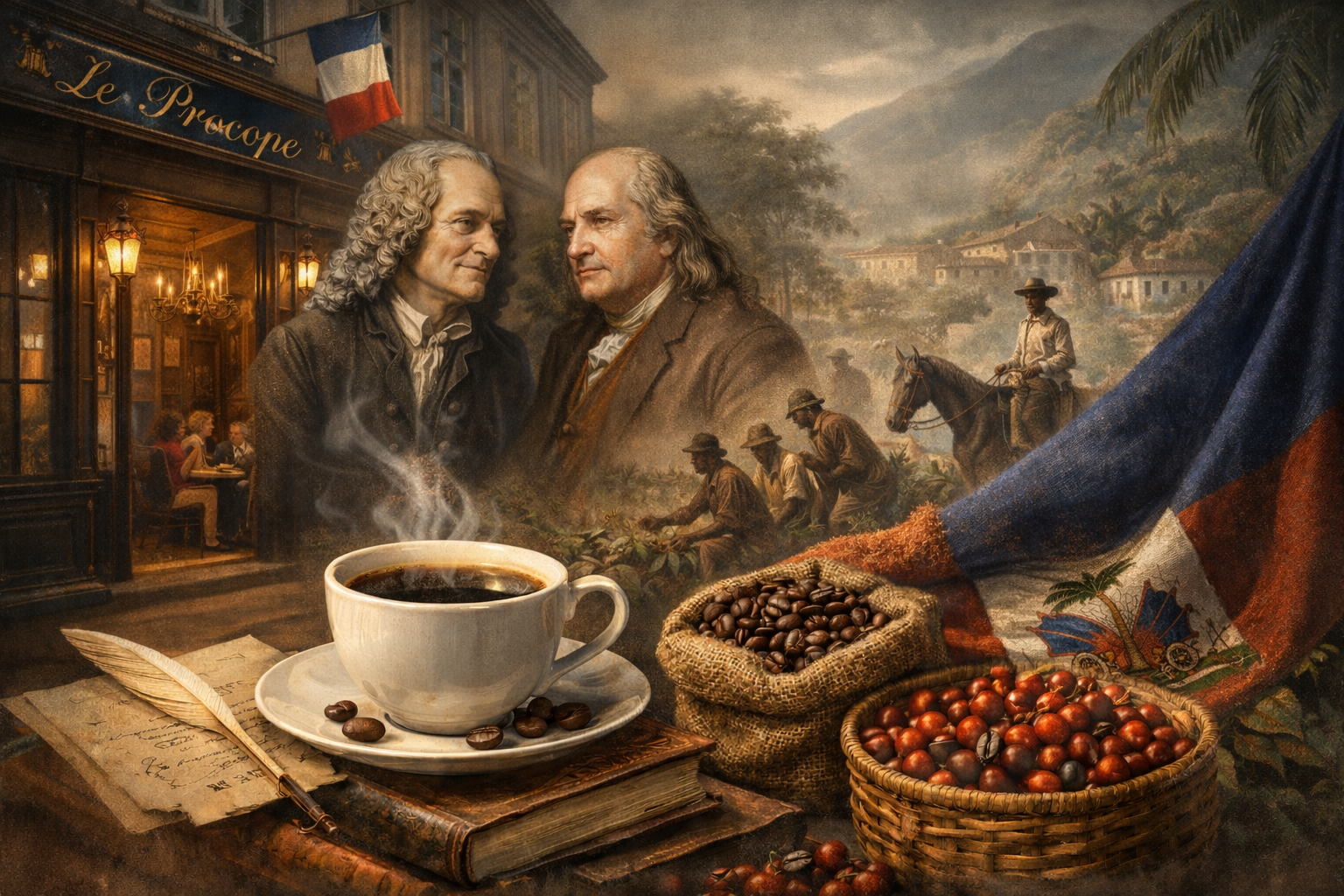
At the heart of this culture stood Café Procope, founded in 1686 and recognized as France’s oldest café. It was here that Enlightenment philosophy fermented, revolutions were imagined, and the future of nations was argued over porcelain cups.
But what filled those cups tells a deeper story… one that rarely makes it into European history books.
The Fuel Behind the Enlightenment
By the early 1700s, France’s coffee supply depended overwhelmingly on Saint-Domingue, the French colony imposed on land long known as Ayiti. Renamed and reorganized for extraction, Ayiti’s mountainous terrain was exploited for large-scale coffee cultivation that met Europe’s growing demand. By the eve of the Haitian Revolution in 1791, Saint-Domingue had become the world’s leading coffee producer, supplying the majority of the coffee imported into Europe and shaping the café culture of Enlightenment-era France. That same land is Haiti today, which powered Europe’s intellectual awakening while its own people were denied freedom, recognition, and sovereignty.
The Minds at the Table
Inside Café Procope sat some of the most influential figures in Western political and philosophical history. Voltaire, known to consume vast quantities of coffee daily, debated reason and religious authority. Jean-Jacques Rousseau explored ideas of social contracts and popular sovereignty. Denis Diderot discussed knowledge systems that would become the Encyclopédie. Even Benjamin Franklin, while in Paris, passed through these same intellectual circles.
They spoke of liberty, equality, and the rights of man — while drinking coffee grown on Haitian land by enslaved Africans whose own freedom was denied.
The contradiction is impossible to ignore.
Wealth Without Recognition
The profits from Saint-Domingue’s coffee enriched France, funded salons, and sustained the social spaces where revolutionary ideas matured. Yet when Haiti liberated itself through the only successful slave revolt in history, those same powers refused to recognize its sovereignty without punishment.
The irony is stark: Haiti fueled the Enlightenment, yet was excluded from its promises.
Why This Still Matters
European café culture is still romanticized as the birthplace of modern democracy and free thought. Still standing in Paris’s Latin Quarter near the Odéon, Café Procope is revered as a birthplace of ideas. Yet the wealth that sustained its legacy, Haitian coffee harvested through colonial extraction, is seldom part of the story.
This is not about erasing history.
It is about completing it.
Final Thought
France’s oldest café did not rise in isolation. It rose alongside Haiti’s forced transformation into the world’s leading coffee producer, a process built on extraction and erasure. The debates that shaped Europe were carried by coffee from Haitian soil, even as Haiti was written out of the very ideals being discussed.
Ideas flowed freely in Paris.
The wealth that powered them did not.
History doesn’t only live in books.
Sometimes, it lingers in the cup.






Add a comment